ONLINE REGISTRATION
Close

ONLINE REGISTRATION
Close
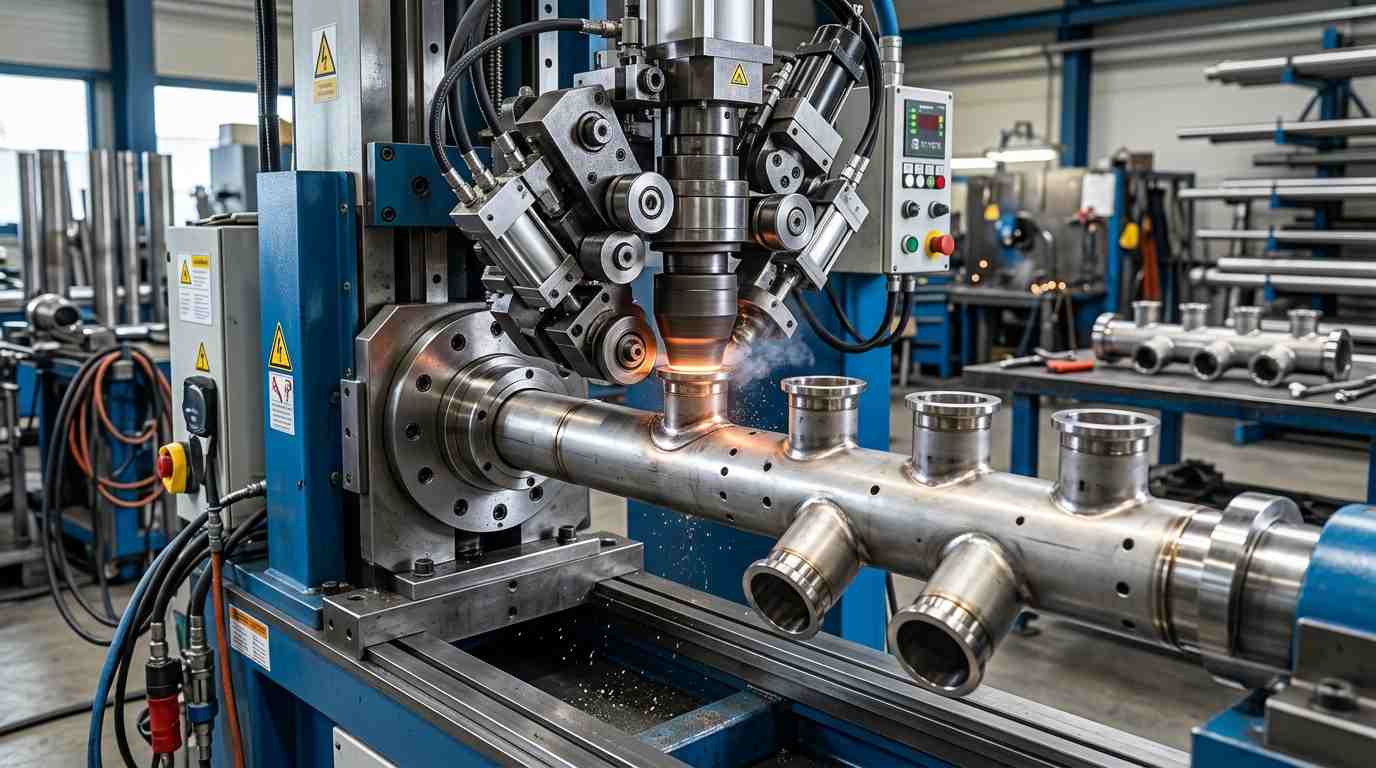
The collaring machine process for manifolds replaces traditional tee fittings entirely. You draw a branch directly from the main parent tube using specialized machinery. This cuts your welding joints in half and drastically drops inspection failure rates while improving fluid flow across the entire piping system.
You take a solid pipe and pull a branch out of the metal itself. Instead of cutting a main pipe and welding in a heavy commercial tee fitting, you manipulate the parent material to form a perfect lip.
This eliminates the need to buy separate fittings for your shop floor. You only need one weld connecting the branch tube to the new lip. Traditional methods require three separate welds for every single junction. Think of how a potter pulls a spout from a clay pitcher. The metal moves the exact same way when subjected to the right localized pressure.
Mastering the collaring machine process for manifolds gives you a massive advantage in shop throughput.
Tube branching machinery uses mechanical force to reshape metal without compromising its structural integrity. The equipment runs a specific sequence to prepare and form the material accurately every single time.
The machine first cuts an elliptical hole into the header pipe fabrication. This shape matters a lot. A perfect circle creates uneven wall thickness during the next step. The ellipse ensures the metal stretches uniformly as the tool pulls it outward to form the neck.
Forming pins enter the pilot hole and expand outward. The machine pulls these pins upward while spinning them rapidly. This upward pulling action draws the metal out to form the collar.
Here is the thing. Operators often rush the extrusion speed. Pulling too fast tears the metal lip and ruins the joint. Let the tool do the work at its programmed feed rate. The collaring machine process for manifolds requires patience during the extrusion phase to maintain strict wall tolerances.
Extruded branch connections outperform traditional fittings across almost every metric that matters to your bottom line. You spend less on materials and less on skilled labor.
But here is where people mess it up. They look only at the machine cost and ignore the daily consumable savings. Let us look at the hard numbers.
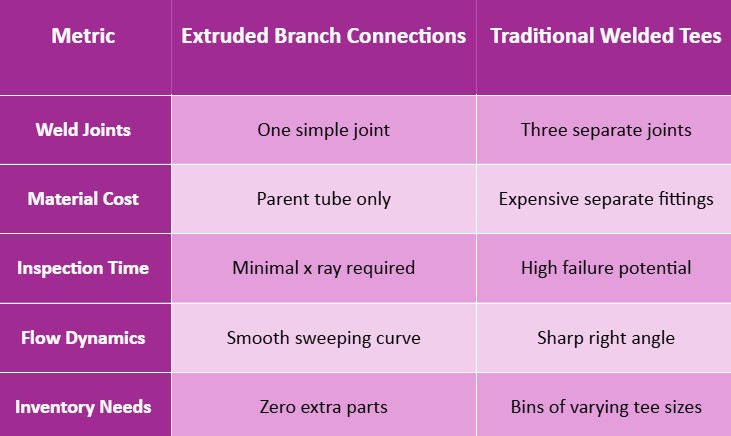
That sweeping curve on the inside of an extruded branch is important. Sharp right angles in traditional tees cause turbulence and pressure drops inside the piping. A pulled collar guides the liquid or gas smoothly around the corner.
Optimizing the collaring machine process for manifolds immediately translates to manifold welding automation. Fewer joints mean your automated orbital welders finish a complete assembly in a fraction of the time.
Yes. Stainless steel collaring is completely standard practice across food beverage and pharmaceutical applications.
You must watch out for work hardening though. Austenitic stainless grades get incredibly hard when you cold form them. If you pull a collar and immediately try to manipulate that branch further, it will crack wide open.
You often need to anneal the joint if the system handles extreme vibration or pressure. Just heat treat the area to relieve the mechanical stress. Carbon steel and copper forgive aggressive forming much better than stainless steel does. If you run a shop doing stainless steel collaring, invest in proper die lubrication. Dry forming stainless destroys your forming pins fast.
Getting the material science right makes the collaring machine process for manifolds highly repeatable.
Labor and inspection eat your margins alive. Every weld requires prep work, a skilled operator, expensive gas consumables, and non-destructive testing.
The collaring machine process for manifolds slashes these costs at the source:
And honestly, fewer welds mean fewer leaks in the field. When a client pressurizes a system, every joint represents a potential failure point. Removing two joints per branch gives everyone peace of mind.
You can easily implement tee branch tube forming techniques into your existing layout. Just update your joint designs and watch your consumable spend drop next quarter. The collaring machine process for manifolds scales perfectly for both low volume custom jobs and high volume production runs.
The collaring machine process for manifolds changes how modern shops operate. You cannot afford to keep paying skilled labor to weld three joints when one joint does the job better. You lose money every time your buyer orders a separate commercial tee fitting.
Implementing this machinery requires precise tooling and serious engineering know how. It is not something you figure out on a scrap piece of pipe in one afternoon.
That is where you call in the experts. UC Design and Fabrication brings decades of specialized experience directly to your shop floor. They help you optimize the collaring machine process for manifolds so you see immediate returns on your production speed. Stop struggling with outdated fabrication methods and start building smarter piping systems today.
Collaring pulls the branch connection directly from the parent tube material. Traditional branching requires cutting the main pipe and inserting a separate commercial tee fitting.
No. The extrusion process maintains material integrity when performed correctly. Engineering standards accept collared branches as structurally sound alternatives to standard fittings under high pressure.
The forming action creates a smooth internal radius at the intersection. This gentle curve prevents fluid turbulence and minimizes pressure drops across the entire piping system.
Limits depend entirely on the specific machinery power. Standard equipment easily handles thin wall copper while heavy duty hydraulic systems pull collars in thick carbon steel.
You do not need special techniques. The extruded lip provides a perfect standard butt weld joint. Welders use standard manual tig or automated orbital welding equipment.