ONLINE REGISTRATION
Close


ONLINE REGISTRATION
Close
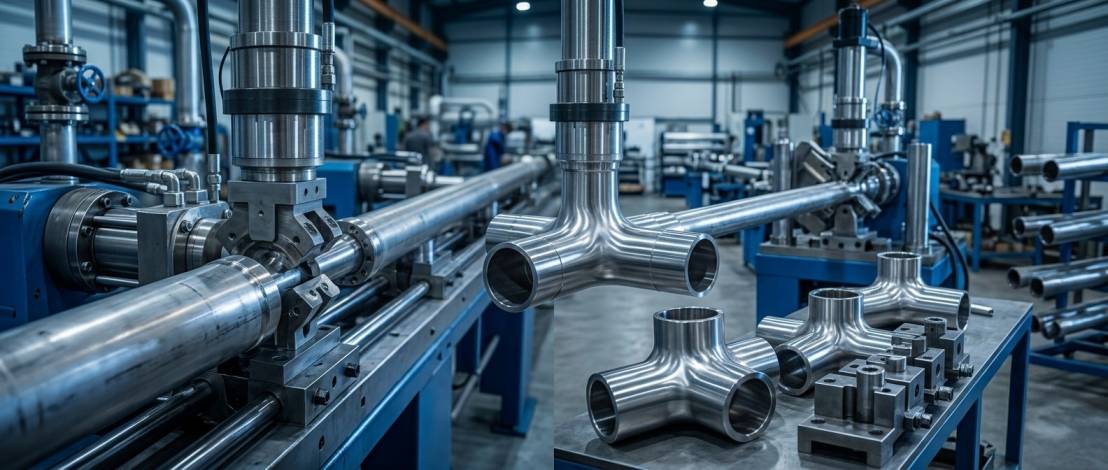
You don’t need a separate fitting for every branch connection.
This method draws a collar straight out of the run pipe’s own wall. The branch tube welds into that collar. No olet in the parts bin. No extra weld joint at the base, and no waiting on a forged fitting to show up. Cut the hole, form the collar, weld the branch. That’s the whole method.
And honestly that simple shift transforms your entire fabrication floor.
Most shops still default to cutting the header and welding in three places just to add a single branch. That method eats up labor hours and introduces multiple potential failure points.
Think of it as stretching the metal rather than replacing it. T outlet forming uses specialized tooling to draw a neck out of a continuous pipe run. You end up with a smooth opening ready for a butt weld. It looks like a small volcano rising from the pipe wall.
The industry also calls this the collaring process or tube branching.
You take the main pipe and clamp it down securely. The machine then pulls the wall material outward to exact dimensions.
This approach requires serious mechanical force but leaves the original pipe structurally intact. Compare that to chopping a twenty foot section of pipe into pieces just to insert standard fittings. Every cut compromises the original integrity of the system. Leaving the main run solid creates a superior fluid path.
The biggest win comes down to simple math on the shop floor.
A traditional tee fitting requires three separate welds to complete the branch pipe connection. Collaring requires only one weld to attach the branching tube to the extruded neck. Cutting your weld count by two thirds drastically reduces your inspection time and labor costs.
But here is where people mess it up by ignoring flow characteristics. Sharp angles inside traditional fittings cause extreme turbulence and friction.
The sweeping radius created by T outlet forming allows liquids and gases to flow without restriction. Fluids glide through the intersection instead of slamming into a hard corner. That smooth transition significantly extends the lifespan of your pumps and valves.
It changes everything for high pressure systems.
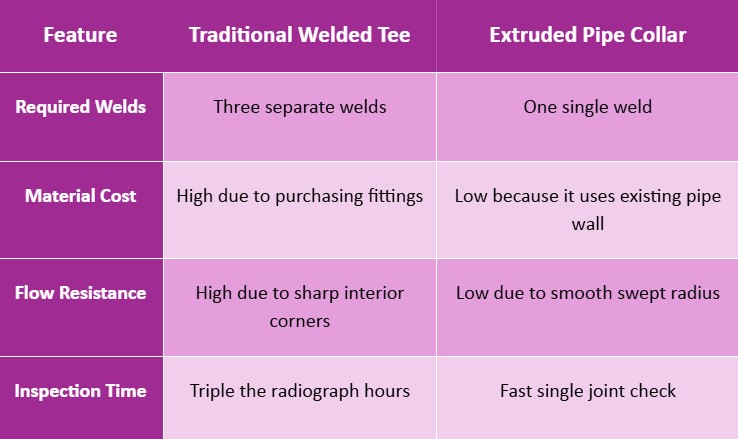
You need specific equipment to make T outlet forming happen consistently. A modern T drill machine handles the heavy lifting in a few specific stages.
The procedure goes like this:
It is often seen that people try to rush the facing step all the time. They think the extruded edge looks good enough for a quick tack weld. Well, it never is. Taking an extra sixty seconds to face that rim flat prevents massive headaches during radiograph inspection.
Doing it right the first time keeps the inspectors happy.
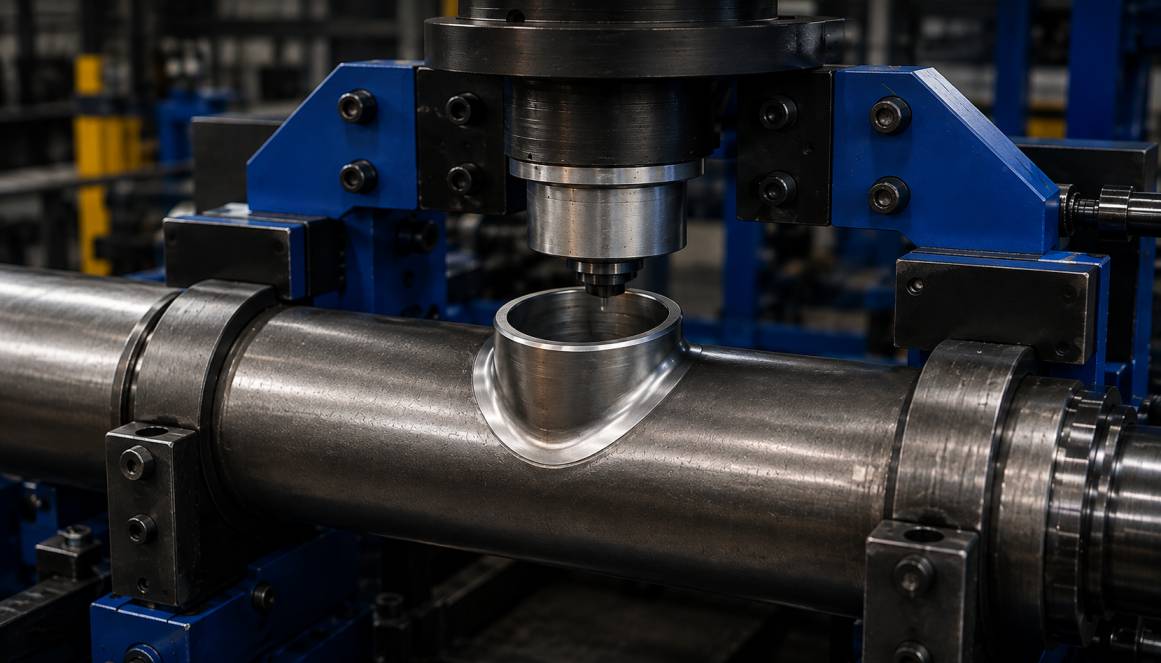
You can pull a collar on almost any ductile metal used in commercial plumbing.
Stainless steel and copper are the most common candidates because they stretch predictably without tearing. Carbon steel works fine too but requires different tooling and lubrication setups. The trick is matching your extraction speed to the specific material hardness.
Here is a classic shop floor mistake. An operator switches from thin wall stainless to heavy carbon steel but leaves the feed rate exactly the same.
The carbon steel pipe inevitably cracks right at the base of the collar.
Different alloys need different handling during T outlet forming. You have to slow down the pulling pins for harder materials. Skimping on the pulling lubricant is another fatal error that ruins expensive header pipes. Generous lubrication keeps the forming pins from destroying the inside of the new neck.
Clinging to old methods costs your business money every single day. Upgrading your manifold production limits failure points and gets products out the door much faster.
That translates directly to higher profit margins on complex piping jobs.
If you want to implement T outlet forming correctly without the learning curve, bring in experts who already know the tolerances. UC Design and Fabrication delivers the exact precision you need for high performance piping systems. Let us handle the heavy lifting while you focus on scaling your operations. Give your clients the durable systems they deserve.
Yes. Eliminating two welds removes the most common points of failure. The extruded collar acts as a continuous extension of the main pipe, providing excellent pressure resistance and durability.
Pulling the metal outward does reduce the collar thickness slightly. Proper tooling minimizes this reduction to ensure the remaining wall thickness easily meets strict industrial piping safety code requirements.
No. The branch pipe must be smaller than the main header. You cannot pull a four inch collar out of a four inch pipe without destroying the structural integrity completely.
Inspectors use standard visual checks alongside ultrasonic testing to verify wall thickness. Dye penetrant testing confirms no micro cracks developed around the base radius during the mechanical collaring process.
Yes. The single joint connecting your branch pipe to the new collar requires the exact same radiographic inspection as any standard butt weld joining two separate pieces of industrial metal.
