ONLINE REGISTRATION
Close

ONLINE REGISTRATION
Close
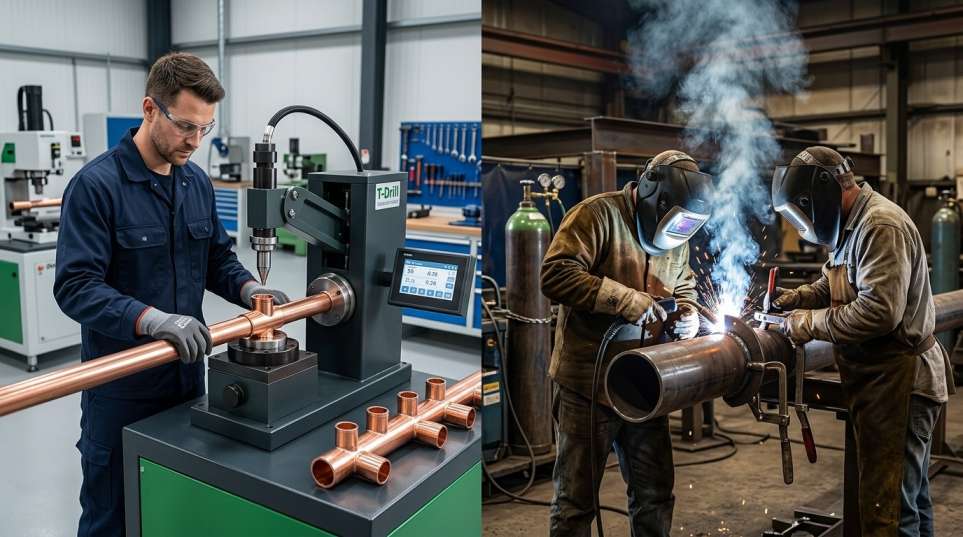
Process piping systems require strong and reliable branch connections. Every connection influence safety, efficiency, and operating costs. Therefore, selecting the right branch connection method is essential.
Many engineers compare T-Drill collaring with traditional branch welding before starting a project. While both methods produce long-lasting branches, there are differences in the various aspects of their use, including cost, time of installation, maintenance, and long-term performance.
These differences are important to understand and can help project managers, fabricators, and engineers make informed decisions.
T-Drill collaring is a cold-forming process that makes a branch outlet directly from the main pipe. Special equipment is used to create a reinforced collar around the opening, rather than welding a separate tee fitting.
The branch pipe then fits into the collar. This process reduces the fitting count and forms a good connection. This technique is therefore applied in several industries to enhance fabrication efficiency.
Traditional branch welding connects a separate fitting to the main pipeline. Workers first cut the pipe before positioning the branch fitting. They then complete several welds to secure the connection.
This method has served industrial piping systems for decades. Moreover, it remains common in demanding applications. Many industries trust traditional welding because of its long history and proven performance.
Installation speed directly affects project schedules. T-Drill collaring creates the branch from the existing pipe. Therefore, workers install fewer components.
Additionally, fewer welds reduce fabrication time. As a result, projects often finish sooner. Traditional branch welding requires more preparation.
Workers must:
Consequently, installation usually takes longer.
Material costs influence every fabrication project. T-Drill collaring eliminates many separate fittings. Therefore, projects require fewer materials. Furthermore, fewer welding consumables reduce expenses.
Traditional branch welding needs:
Although each item may seem inexpensive, the total cost increases on large projects.
Labor represents a significant project expense. T-Drill collaring reduces fabrication steps . Therefore, workers spend less time creating each branch connection.
Moreover, fewer welds lower labor requirements. Traditional welding requires additional cutting, fitting, welding, and inspection. Consequently, labor costs often increase.
For projects with many branch connections, the savings from T-Drill collaring become even more noticeable.
Performance remains the most important consideration. T-Drill collaring creates smooth branch transitions. Therefore, fluid flows more efficiently through the system.
Additionally, reduced turbulence lowers pressure loss. Traditional branch welding also performs well. However, internal weld profiles may slightly increase flow resistance. Even so, both methods provide dependable performance when fabricated correctly.
Strength depends on proper engineering and fabrication. The branch welding technique has been used for decades in industries with great success—excellent performance in challenging conditions.
T-Drill collaring, when designed to pertinent standards, also provides excellent strength. Proper fabrication ensures reliable service regardless of the selected method.
Maintenance affects long-term operating costs. T-Drill collaring uses fewer welded joints. Therefore, there are fewer potential leak locations.
Additionally, inspections become simpler. Traditional branch welding contains more welds. Although quality welds remain durable, every weld requires routine inspection. Regular maintenance supports safe system operation for both methods.
T-Drill collaring works well in many industries.
Common applications include:
These industries benefit from faster fabrication and improved flow efficiency.
Traditional welding remains the preferred option for demanding industrial services.
Typical applications include:
These environments often require maximum structural strength.
Every project has unique requirements.
Before selecting a branch connection method, evaluate:
Considering these factors helps achieve reliable long-term performance.
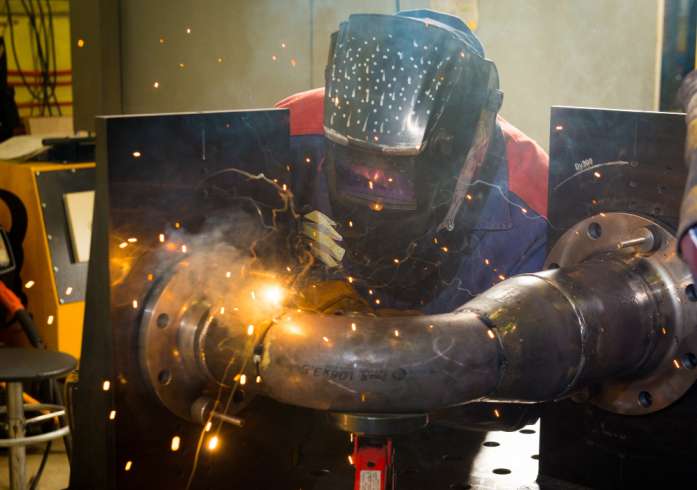
The answer depends on your project goals. T-Drill collaring reduces fabrication time, labor, and material costs. Therefore, it delivers excellent value for many piping systems.
Traditional branch welding offers exceptional durability for demanding industrial environments. Consequently, it remains the preferred choice for critical applications. Working with experienced fabrication professionals helps determine the most suitable solution.
Both T-Drill collaring and traditional branch welding provide dependable branch connections for process piping systems. Selecting the right method requires careful evaluation of operating conditions, engineering requirements, and industry standards.
Whether your project requires T-Drill collaring, traditional branch welding, or complete pipe fabrication services , UC Design & Fabrication delivers precision, quality, and dependable solutions tailored to your operational needs. Contact our experienced team today to discuss your next process piping project.
It reduces fittings, welding, fabrication time, labor costs, and maintenance, and improves overall piping system efficiency significantly.
Traditional welding handles demanding pressure and temperature conditions while delivering proven long-term structural reliability consistently.
T-Drill collaring usually lowers material, labor, fabrication, inspection, maintenance, and overall project expenses for industries.
Food processing, pharmaceuticals, water treatment, HVAC, utilities, and chemical plants commonly benefit from T-Drill collaring.
Evaluate pressure, temperature, budget, maintenance, regulations, fabrication requirements, and long-term operational performance before selecting.