ONLINE REGISTRATION
Close

ONLINE REGISTRATION
Close
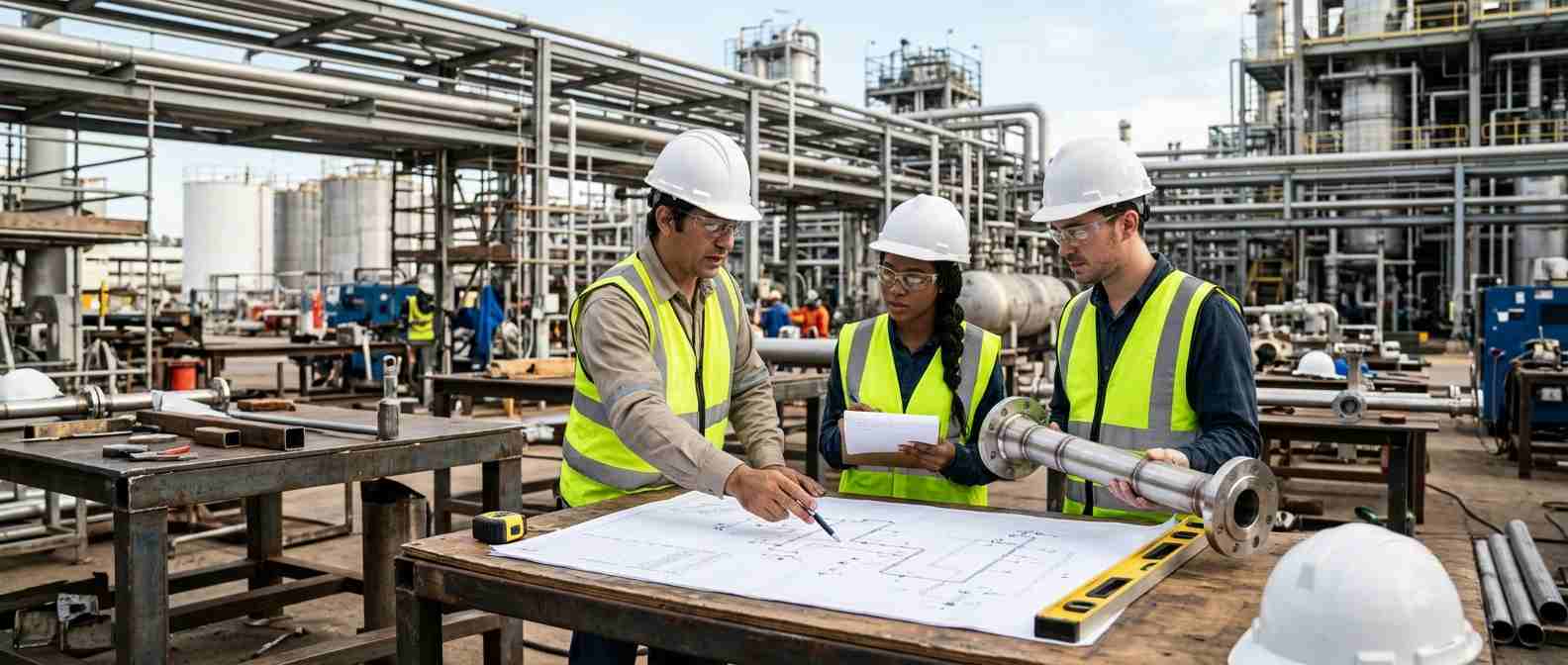
Process piping systems are a critical part of the day-to-day operations of industrial facilities. They move liquids, gases, chemicals and other materials from one production area to another. Thus, their quality has a direct impact on the safety of plants, operational efficiency and the reliability of equipment.
But the installation of pipes is not just about choosing the right pipes and fittings. Care must be taken at every stage, from material selection to fabrication, welding, inspection and testing. Small inaccuracies in fabrication can result in leaks, pressure issues, unexpected downtime, and costly repairs.
A checklist for plant managers and engineers to follow when creating a plant piping fabrication process helps keep the process on track and avoid unnecessary problems. These are the key considerations to take into account before giving the go-ahead to any process piping fabrication project.
Check all engineering documents thoroughly before making any parts. These documents are used for accurate fabrication and installation.
Plant managers and engineers should check:
Verify fabrication drawings are current with the most recent approved engineering changes. Any discrepancies should be resolved before production starts.
ASME B31.3 is applicable to the design, material, fabrication, examination and testing of industrial process piping for many projects.
The choice of materials is important to the performance of piping systems. The wrong material can lead to corrosion, failure or compatibility issues. Determine if the chosen materials are suitable for the project’s operating conditions.
Important considerations include:
The traceability of the materials is also crucial. Appropriate identification of each pipe, fitting and component should be maintained throughout fabrication. This process allows engineers to be sure that the right materials go into production and can be identified during inspections.
Quality of fabrication is dependent upon appropriate equipment, trained personnel and procedures. Assess the fabricator’s capabilities prior to production. Confirm that the facility has the equipment needed to meet the project’s specifications.
Your checklist should contain:
Orbital welding and mechanical polishing are processes that can be used to ensure consistent fabrication quality for specialized stainless steel systems. In addition, check that equipment calibration records are up to date as necessary.
Welding is one of the most crucial steps in the process of making up piping. Welds that are not properly made can lead to leaks, structural issues, and contamination problems. Plant managers and engineers should ensure welders have appropriate qualifications and are using approved Welding Procedure Specifications (WPS).
Review these important points:
Orbital welding can be used for sanitary and high-purity applications and can yield repeatable weld quality if qualified and controlled.
Process materials can flow from one area of a piping system to another via branch connections.Their design and fabrication directly affect the system performance. Engineers should test tees, reducers, elbows, flanges and other fittings prior to approving fabricated assemblies.
Check the following:
For appropriate applications, mechanically formed or T-drilled branch connections may be an alternative. These connections are made directly from the parent pipe wall, which may decrease the need for extra fittings and welding.
Inspection and testing are used to detect fabrication defects prior to entering service. Create an Inspection and Test Plan (ITP) which outlines the stages of inspection, who is responsible for each stage, the acceptance criteria, and what documentation is required.
Your inspection checklist should cover:
Testing procedures should be in accordance with the relevant code and project requirements. Document all findings and address any rejected inspections prior to moving on.
Surface finishing is particularly important for stainless steel process piping. The finishing process may have an impact on the corrosion resistance, cleanliness, and system performance if it is not done properly. Check the inside and outside of pipes for contamination, rough edges, weld discoloration, and other defects.
Take these finishing requirements into account:
Passivation according to ASTM A380/A967 (if applicable) restores the passive surface condition of stainless steel.
Full documentation demonstrates that fabrication activities have been carried out to satisfy project needs. It also facilitates future maintenance, troubleshooting and regulatory reviews.
Prior to accepting fabricated piping, gather and examine:
Make sure that all documents are neatly arranged and easily accessible to the plant’s maintenance and engineering staff.

With a reliable fabrication partner, it’s easier to maintain the quality of an industrial piping project. Seek out experience in stainless steel, qualified welders, code-compliant fabrication, traceability and complete inspection.
UC Design & Distribution provides precision pipe fabrication, orbital welding, T-drilled branch connections, passivation, and quality documentation for industrial projects.
Planning a new process piping installation or upgrading an existing plant? Partner with UC Design & Distribution for precision-focused fabrication solutions. Contact our team today to discuss your project requirements and build a reliable piping system that supports long-term operational performance.
A fabrication checklist helps plant managers and engineers maintain quality, verify materials, prevent fabrication errors, improve safety, and ensure piping systems meet project specifications.
Stainless steel grades such as 304, 316, and 316L are commonly used because they offer strength, durability, and corrosion resistance.
Common inspections include visual examination, dimensional checks, non-destructive testing, material verification, weld inspections, and pressure testing to confirm fabrication quality and system reliability.
Qualified welders follow approved welding procedures, helping ensure consistent weld quality, reduce defects, prevent leaks, and maintain the structural integrity of piping connections.
Engineers should review material certificates, welding records, inspection reports, dimensional checks, pressure test results, surface finishing, and final quality documentation before approval.